North America Dive Flag

Kevin O'Brien


PADI Course Director

PADI Tec Instructor Trainer

PADI Prism2 CCR Instructor


International Dive Flag


Home

About Me

Contact Me

Site Map


Recreational Scuba

Training Courses

Open Water Diver

Adventure Diver

Advanced Open Water Diver

Rescue Diver

Master Scuba Diver


Specialty Diver

Training Courses

Boat Diver

Caribbean Sea Turtle Identification Diver

Deep Diver

Digital Underwater Photographer

Dive Propulsion Vehicle (DPV) Diver

Drift Diver

Drysuit Diver

Emergency Oxygen Provider

Enriched Air Nitrox Diver

Equipment Specialist

Fish Identification Diver

Full Face Mask Diver

Ice Diver

Lionfish Hunter

Night Diver

UV Night Diver

Peak Performance Buoyancy

Search & Recovery Diver

Self-Reliant Diver

Shore Diver

Sidemount Diver

Surface Marker Buoy (SMB) Diver

Underwater Naturalist

Underwater Navigator

Wreck Diver

Yoga Diver


Technical Diver

Training Courses

Tec Basics Diver

Tec 40/Tec 40 Trimix Diver

Tec 45/Tec 45 Trimix Diver

Tec 50/Tec 50 Trimix Diver

Tec Sidemount Diver

Tec Trimix 65 Diver

Tec Trimix Diver

Nitrox Gas Blender

Trimix Gas Blender


Professional

Training Courses

Divemaster

Assistant Instructor

Open Water Scuba Instructor

Master Scuba Diver Trainer

IDC Staff Instructor

Master Instructor


Specialty Instructor

Training Courses

Boat Diver

Deep Diver

Digital Underwater Photographer

Dive Propulsion Vehicle (DPV) Diver

Drift Diver

Drysuit Diver

Emergency Oxygen Provider

Enriched Air Nitrox Diver

Equipment Specialist

Fish Identification Diver

Full Face Mask Diver

Ice Diver

Lionfish Hunter

Night Diver

Peak Performance Buoyancy

Search & Recovery Diver

Self-Reliant Diver

Shore Diver

Sidemount Diver

Surface Marker Buoy (SMB) Diver

Underwater Naturalist

Underwater Navigator

Wreck Diver


Technical Instructor

Training Courses

Tec Instructor

Tec Deep Instructor

Tec Sidemount Instructor

Tec Trimix Instructor

Nitrox Gas Blender Instructor

Trimix Gas Blender Instructor


Rebreather Diver

Training Courses

Discover Rebreather

Rebreather Diver

Advanced Rebreather Diver

Tec 40 CCR Diver

Tec 60 CCR Diver

Tec 100 CCR Diver


Emergency First Response

CPR / First Aid Courses

CPR & AED (Primary Care) for Adults

First Aid (Secondary Care) for Adults

CPR, AED & First Aid for Adults

CPR, AED & First Aid for Children

CPR, AED & First Aid Instructor


Ready to explore the world of rebreather diving ... become a PADI Rebreather Diver


Ready to explore the world of technical diving ... become a PADI Tec 40 Diver


PADI Rebreather Diver


Ready to explore the world of rebreather diving ... start your training with PADI Rebreather Diver! The PADI Rebreather Diver course is the first level of recreational rebreather training in PADI's rebreather training programs. Rebreather Diver is an entry-level recreational rebreather diving program that introduces divers to recreational rebreather diving. A PADI Rebreather Diver is qualified to make no-decompression dives using a rebreather to depths not deeper than 18m/60ft.


NOTE: PADI rebreather programs are rebreather-specific. We will be using a Hollis Prism2 rebreather for the Rebreather Diver course.


NOTE: The PADI Rebreather Diver and PADI Advanced Rebreather Diver courses can be integrated and completed together if the student diver meets the entry requirements for the Advanced Rebreather Diver course.


Course Prerequisites

• PADI Open Water Diver or equivalent

• PADI Enriched Air (Nitrox) Diver or equivalent

• 25 logged dives

• Minimum age 18


What You Will Learn

During the Rebreather Diver course, you will learn how to conduct rebreather diving to depths of 18m/60ft, including:

• Differences between open circuit diving & rebreather diving

• Types of rebreathers

• Basic components of a rebreather & their functions

• Rebreather assembly, disassembly, cleaning & storage

• Packing/preparing a scrubber

• Use of pre-dive checklists

• Rebreather diving procedures & techniques

• Potential rebreather problems

• Work of breathing & counterlung positions

• CO2 absorption & O2 comsumption

• High and low O2 issues

• No decompression rebreather dive planning

• CO2 absorption & O2 comsumption

• Rebreather diving with open circuit divers

• Emergency procedures for rebreathers


Performance Requirements

PADI Rebreather Diver course training is typically conducted with 3 classroom training sessions and 3 practical application sessions, followed by 1 confined water training dive and 5 open water training dives. There are reading assignments & Knowledge Reviews required to be completed prior to the start of the Rebreather Diver course. To achieve certification, you will need to:

• Complete the Rebreather Diver reading assignments & Knowledge Reviews provided by your Rebreather Diver instructor.

• Complete (3) classroom training sessions with your Rebreather Diver instructor & successfully complete the Rebreather Diver final exam.

• Complete (3) Rebreather Diver practical application sessions with your Rebreather Diver instructor.

• Complete (1) Rebreather Diver confined water training dive and (5) Rebreather Diver open water training dives with your Rebreather Diver instructor.


Course Format

The PADI Rebreather course is typically conducted over 3 days with classroom & practical application sessions each morning, followed by training dives at local dive sites.


Course Schedule & Cost

PADI Rebreather Diver courses are conducted through the dive stores that I work with, including VIP Diving. Please check their website for the most current PADI Rebreather Diver training schedule and course costs.


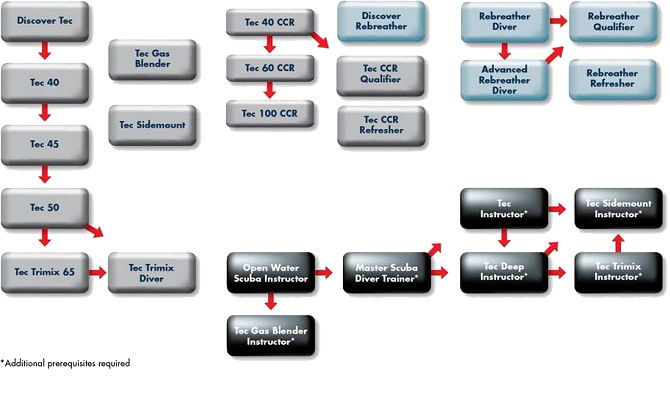
 PADI Tec Diver Certifications Roadmap


NOTE: All information is believed to be accurate as posted. However, PADI, Emergency First Response, DSAT and related training standards are periodically revised to enhance training and ensure student diver safety. Therefore, the information on this website may not always reflect recent changes to training standards.


© 2012-2025 KOBScuba.com  All rights reserved.